
It’s becoming increasingly difficult to put my fingers in my
ears and pretend it’s still summer. I'm currently packing
up to return to university, and I get the feeling that once all my thick
jumpers are in the bag, there’ll be no room for an optimistic dress or two. I’m
just back from the North Yorkshire coast, where the beaches are looking pretty
devoid of people (though the dogs seem happy that they're allowed to play there again). But while the sunlounger season might be truly dead,
those willing to throw on wellies and a coat will find that hunting for
wildlife on the coast is never out of season. Seals are breeding on many
beaches this month, and a brisk walk along the shore can result in many
interesting finds as storms throw up unusual shells, seaweeds and
other organisms from further out to sea. Rockpools are recovering from being
poked and prodded all summer long, and are still going about their tide-centric
business, if you care to look. Today’s entry is all about two very familiar
species to anyone who has so much looked at a rockpool: limpets and barnacles.
 |
| Checkmate. |
Why those, you might say. Not as fun as crabs, you might
say. They’re practically the same thing as one another, aren’t they?
Cone-shelled stuck-to-a-rock things. Different sizes, that's all. I’m going for an
ice cream, screw this.
Wait!
What if I told you that barnacles and limpets are about as
related to one another as you are to a starfish? We tend to see them when the
tide’s out and they’ve temporarily shut up shop- but when you see these animals
in action, it’s quite clear that they’re leagues away from one another.
Limpets are molluscs, and close cousins of the snails in your garden. This only becomes obvious when
the tide is in and the limpet releases its iron grip on the rock, poking out a
stubby pair of eye-stalks from under its shell. It then crawls along the rocks
at a predictably slow pace, scraping delicious algae off the rocks with its rough
tongue, known as a radula (if there ever was an onomatopoeic body part…). As
the tide starts to recede, the limpet undergoes a race against time to get back
to its preferred resting spot: each limpet forms a “scar” in the rock that fits
the edges of its shell perfectly, allowing it to perfect that famously powerful
grip on the substrate. As well as defending themselves from curious children, limpets
use their suction powers to withstand strong waves, and avoid evaporation of
water from their moist bodies between tides. The rock scars can sometimes be
seen at low tide where an unfortunate limpet has not made it home, and
sometimes, fights can break out over a prime location. As you can imagine,
they’re not the most high-octane battles in the world.
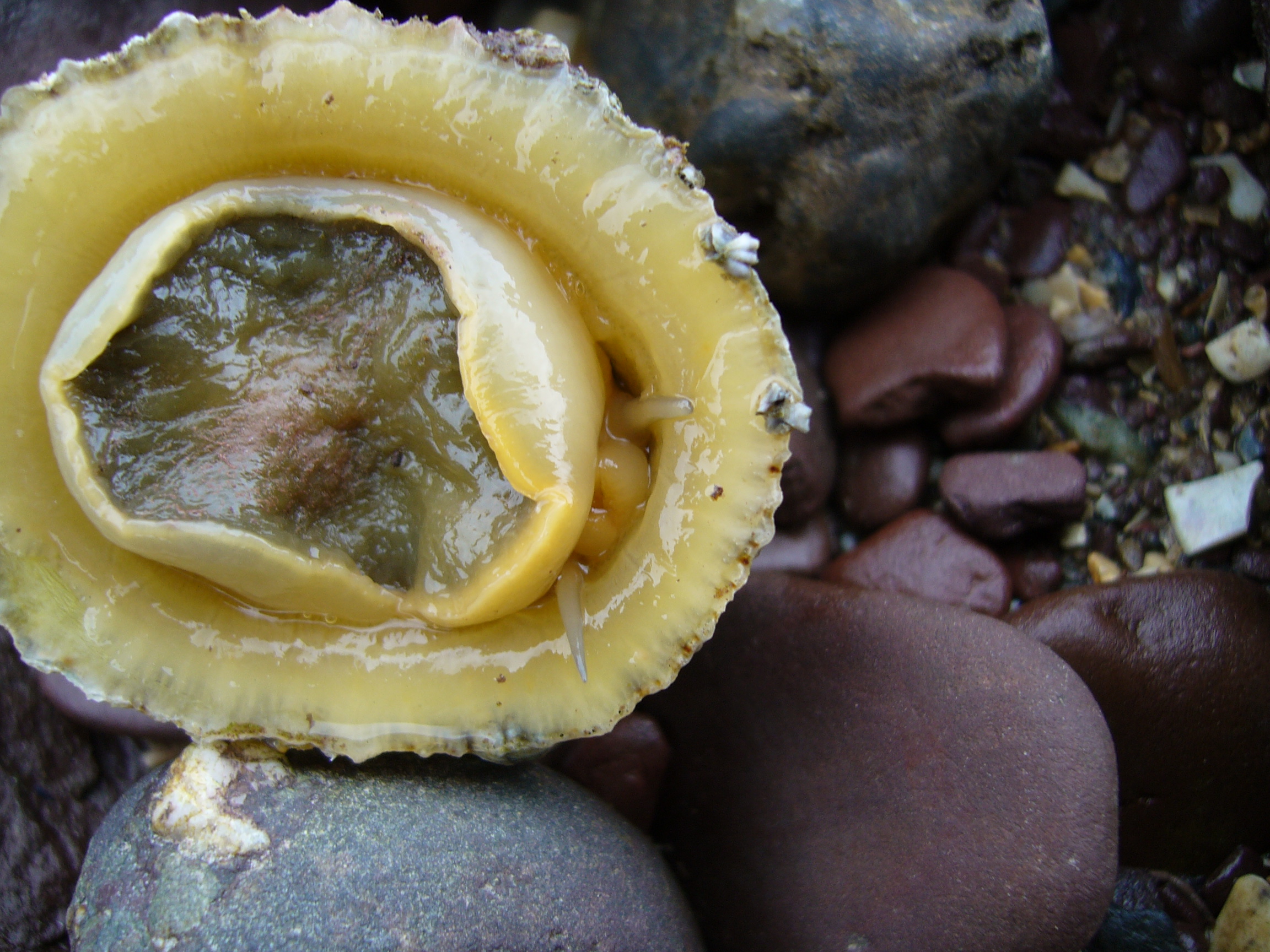 |
| There is no family of animals more guilt-inspiring than the snails. That feeling when you step on a garden snail... or finally manage to pull a limpet off a rock... Yeah, squirm away: you're a bad person. |
Barnacles, too, are very unusual animals. Believe it or not,
they are crustaceans- like crabs, lobsters, woodlice and shrimps- but they have
adopted a lifestyle in which no swimming or walking sideways is involved.
Unlike limpets, once stuck to the rocks they never move: their opening to the
outside world is in the top of the shell, which is usually closed over. Crustaceans, along with
insects, arachnids and the centipede family, belong to a phylum called the
Arthropods- which literally means jointed legs. They have a unique ability to
develop flexible appendages that are split into segments, which can be adapted
to a very wide range of jobs- not just legs! Whether it’s antennae…
_.jpg/580px-Stenopterus_rufus_(antennae)_.jpg)
feeding apparatus…
.jpg/750px-Biiig_Jumping_Spider_-_Head_Crop_(7207612186).jpg)
gills…

or defences…


…jointed appendages all have a common developmental origin,
and it doesn’t take much fiddling with arthropod genes to turn one kind of
appendage into another! Barnacles have also found several ways to use their
appendages, allowing them to avoid the drawbacks of never moving. Here’s what a
barnacle looks like inside its shell:


Don’t judge him, he’s happy. Those blue bits are his cement
glands- essential for any organism hoping to stick to a whale’s face when
it smacks it against the water at high speed descending from a dramatic,
tourist-pleasing leap. Those branched bits at the top are his feeding
appendages- basically adapted legs. When the tide is in, the barnacle uses
these to snatch any tasty morsels floating by, passing them to its mouth (the
smile may have had some artistic licence involved…). And that great big pink
curly thing- that’s his tail, right? Right?
Nope. That there is barnacle penis.
Barnacles have a bit of a dilemma, you see. Most animals
that spend their lives stuck to the substrate... sponges, corals, sea squirts...breed by releasing sperm (and sometimes eggs) into the water, and hoping that they find a partner in
the wide, wide ocean. But crustaceans have evolved to copulate- that is, seek
out a partner and swap goodies directly. It’s not always easy to “un-evolve”
the strategy of your ancestors, and for barnacles, it seems it was much simpler
to adapt the old system to a comic degree than start all over again.
Basically, they have ended up with the biggest penis relative to their body
size of any animal: yet another adaptation of those useful jointed appendages. And
every now and then, a barnacle will unravel this monster into the water (up to
8 times its body length), extending it to all of its neighbours in turn, where it
delivers a lovely little gift of sperm. I hope they knock first. Happily,
barnacles are all hermaphrodites, so there are no awkward sperm exchanges or
sad bachelor colonies: it’s all one big crustacean cock-fest. The longer your
penis, the more neighbours you can mate with, and the more baby barnacles you can make. Where are the drawbacks?!
Actually, the drawbacks might make you wince. Waving a great
long schlong around when the waves are rough is just asking for tearing and
damage, and scientists were interested to see how this affected the design of barnacles’
penises under different conditions. After a lot of measuring (and quite a bit
of giggling, probably), they found that barnacles of the same species living in
rougher waters had shorter, bulkier willies than those living in sheltered
spots: an alteration to reduce drag by currents. What’s more, if you transplant
a rough-shore barnacle to a quiet shore or vice versa, they will gradually alter
their penises to suit the new neighbourhood. When in Rome…
I guarantee that there are now several blokes out there
dreaming of a utopian future in which science has given mankind the gift of altering
their penis size on command. One size for playing football, another for the
nightclub, one for peeing without getting out of bed… who’d ever think you could be jealous of a barnacle? Be sure to salute them next time you're searching for their crab cousins (and stepping all over their heads in the process).
Image credits:
Barnacles and limpet: Zephyris
Upside down limpet: Tango22
Antenna: Jgad
Jumping spider: Harald Hoyer
Lobster: Cefaclor
All from Wikimedia Commons, under Creative Commons Attribution-Share Alike license
Barnacle doodle: by Me :]
Barnacle doodle: by Me :]

No comments:
Post a Comment