
Here’s one of many gorse bushes I came across on the North
Cornwall coast the other week. Looks a bit odd, doesn’t it? Like someone’s
chucked a load of electric cable or silly string over it. Vandals!

Well, actually, that reddish stuff is a plant- and it’s very
much alive. Cuscuta, also known as
dodder, makes something of a dishonest living. You won’t ever find it away from
other plants- in fact, it’s incapable of living independently. Whilst we
usually think of parasites as creepy little animals, some members of the plant world have
also managed to embrace this lifestyle, just as some have mastered a
carnivorous diet. But don’t worry- you’re not going to have a weed plug its
roots into your veins and suck you dry while you sleep. Parasitic plants tend
to stick within their own kingdom (some take advantage of fungi, but that’s a
whole other story). How dependent each species is upon its host plant varies
greatly. Some look pretty normal, and simply top up their water, mineral and/or
carbohydrate supply from their neighbours, whilst still gathering their own.
Others, like dodder, have become extremely specialised and no longer
photosynthesise for themselves, gaining all the nutrients they need from the
host. Such parasites can start to look very unlike plants indeed! With no need
for chlorophyll, they may become a ghostly white, and as cumbersome leaves are
now unnecessary, they are often reduced to tiny scales on the stem. This leaves
more energy for growth of other parts of the plant, and reproducing. The world’s
biggest flower, Rafflesia arnoldii, is a parasite: it measures up to a metre in
diameter and, lacking leaves or roots, is dependent on rainforest vines for all
its nutritional needs. It’s not the sort of thing you want in a vase on your
windowsill, honest.
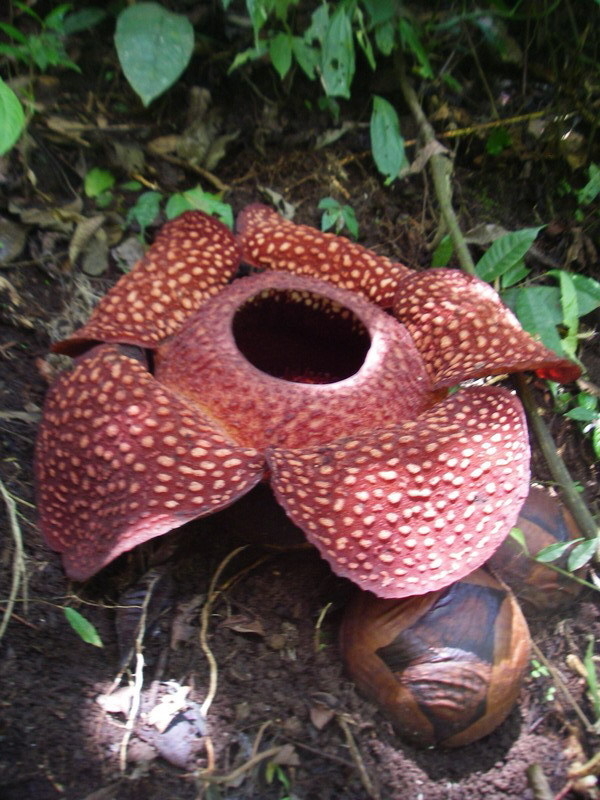 |
| Don't sniff it, either. |
What’s so great about being a parasitic plant, then? What
are the perks of being a pest? Well, for those that are only part-time
parasites, it’s like tapping into your neighbours’ WiFi- you can be afford to
be a little bit more wasteful, because you’re not paying the bills! Plants
gather carbon dioxide from the environment via little pores called stomata on
the underside of their leaves. These can’t be left open for too long, however,
as they’re also a great place for water to evaporate from- a process called
transpiration. But parasites that steal water from their hosts can afford to
leave their stomata open for longer, essentially leaving the tap running: it’s
not their water they’re wasting! More CO2 means more photosynthesis,
so a stronger, healthier parasite! In fact, higher transpiration can be a
strong tool in parasitism: many parasites hook up their water-carrying “veins”
(or xylem) directly with those of their host. Losing water through the stomata
causes suction in the xylem, pulling more water up the plant- if the parasite
can suck more strongly than its host, it can pull more water and dissolved
nutrients out of its victim. Some plants can also exploit the host’s phloem-
the sugar-carrying network- by wrapping a special organ called a haustorium around the phloem tube and
drawing out the sugars produced by photosynthesis. Mistletoes (give us a kiss,
luv) mostly photosynthesise independently, but use the extra energy gained from
their tree hosts to cheat at the breeding game. Many species attract birds to
pollinate them using large, nectar-rich flowers, and produce succulent berries
later in the year to encourage the birds to spread their seeds. (Nasty but
true- the mucous coating of the seed makes the birds’ faeces extra-sticky,
requiring them to wipe it off their bums onto a branch- the perfect place for a
baby mistletoe to grow!) Such extravagant rewards would probably be too
energetically expensive for an independent plant of its size- but mistletoe’s
underhand techniques allow it to live a much flashier, more successful
lifestyle.
It’s not always easy being a parasite, though. Unlike ticks
and tapeworms, plants aren’t so good at moving- they’re a bit doomed if they
end up far from a suitable host. The best opportunity to migrate occurs early
on in life, as a seed. For the parent plant that produces the seeds, it’s
usually best to hedge its bets and make loads and loads of seeds in the hope
that some will find a good place to grow. Unfortunately for the new parasites,
this means that each seed has to be cheap to produce: they tend to be small and
thus have few resources on board to allow independent growth. So it’s vital
that they plug into a power source soon after germination- some species may
only have the energy to grow a few inches, and if they can’t find a host in
this space, it’s game over. So to avoid growing in the wrong direction or at
the wrong time, many parasites have the ability to detect chemicals that leak
into the soil from their hosts’ roots: by germinating only when these are
detected, and tracking the concentration gradient, they can find the nearest
outlet. Scientists have tried to use this response in the fight against
witchweed, a serious parasite of grains in Sub-Saharan Africa that is
responsible for large-scale loss of crops, devastating the lives of
poverty-stricken farmers. The idea was to treat the soil before planting, using chemicals that would mimic those from the hosts’ roots. The tiny
witchweed seeds would be tricked into germinating and starting their search for the hosts that aren’t
actually there, eventually running their batteries dry and dying.
Unfortunately, such chemicals have proven far too expensive for poor
communities, and tend to break down in the soil: these days, the focus tends to
be on the management of farmland and the genome of the host crops in the search
for a solution.
Young parasitic plants can tell more about potential hosts
than just their location, however. It’s no good committing to a host for life
if it later turns out to be a poor provider:
some species may be unsuitable as hosts because they have strong
resistance tactics, whilst individual plants could be too weak or sickly to
support a parasite. Our friend dodder tends to search for hosts above the
ground, detecting the gases passed out of the hosts’ stomata and growing
towards them. Research has shown that it has a preference for potential hosts
that have more nitrogen derivatives in these gases- a strong sign that the host
has access to resources that the dodder wants, and is healthy enough not to be
killed by the infection. Parasitic plants have good taste, you see. They don’t
settle for second-best.
 |
| This is what happens when dodder REALLY likes its host. |
It’s a devious lifestyle that doesn’t make them many
friends, but there’s no denying that parasitic plants are pretty special!
Although less-studied than animal parasites, scientists are now gaining deeper
and deeper insights into how they interact with their hosts and the other species
around them. We now know that just a few individuals of some parasitic species
can totally change the dynamics of the local ecosystem, holding back its
favoured hosts and allowing other species to take over. So next time you walk
past a meadow full of flowers drifting gently in the breeze, don’t be fooled:
some of them may be doing pretty nasty things to the others!
Image credits:
Rafflesia: By ma_suska (ma_suska) [CC-BY-2.0 (http://creativecommons.org/licenses/by/2.0)], via Wikimedia Commons
Dodder on tree: By Khalid Mahmood [GFDL (http://www.gnu.org/copyleft/fdl.html) or CC-BY-SA-3.0-2.5-2.0-1.0 (http://creativecommons.org/licenses/by-sa/3.0)], via Wikimedia Commons
Dodder on gorsebush: Me!

No comments:
Post a Comment