
Any documentary or article on ocean life is bound to mention
plankton at some point. It’s a fundamental part of our ocean ecosystems that
sustains countless billions of invertebrates, fish, seabirds and marine
mammals- and by extension, us! Yet we seldom talk about plankton outside its
role in sustaining larger, flashier organisms. Plankton never asked to get
eaten by a whale, but it rarely gets its time in the spotlight unless it’s
being swallowed by something. As a result, many people aren’t all that sure
what plankton actually IS.
 |
| It's this guy... right? |
In fact, plankton is so little-discussed that you could be
forgiven for thinking that it’s the name of a single, tiny and very abundant
species floating in our oceans. As a child, my mum described plankton to me as
“a mixture of plants and animals”, and I therefore imagined it as the lovechild
of a shrimp and Bulbasaur, with clusters of green bulbs on its back and rows of
tiny legs. Yet in reality, when a whale takes an enormous mouthful of
plankton-rich seawater, it isn’t the equivalent of swallowing a tonne of
homogeneous steak. This is more of a varied and colourful stew, with countless
ingredients from multiple kingdoms of life. “Plankton” is not a biological
classification like “mammal” or “rodent”: it’s a title earned through
lifestyle. If you are a living thing that drifts in the water column, then
congratulations: you are plankton. There are some very strange organisms under
this vast umbrella term that really do deserve a closer look… although you may
need to pack a microscope.
Plankton both directly and indirectly support some of the
largest animals on our planet. But it’s not just big creatures that eat
plankton- there’s an entire food web within the planktonic world itself, and
photosynthesising organisms, or phytoplankton, are at the bottom of it.
However, you won’t find anything particularly leafy floating in the soup: the
oceans are the realm of algae. We often think of algae as simply being tiny
plants, but they actually belong to an entirely different kingdom of life to
the terrestrial plants we are familiar with. All land plants- mosses, trees,
flowers, conifers, grasses- evolved from an ancestral aquatic alga that adapted
to dry land around 450 million years ago, and very few of its descendants have made
the transition back to the sea. Under the microscope, algae have an enormous
diversity of shapes and forms compared to their larger terrestrial cousins.
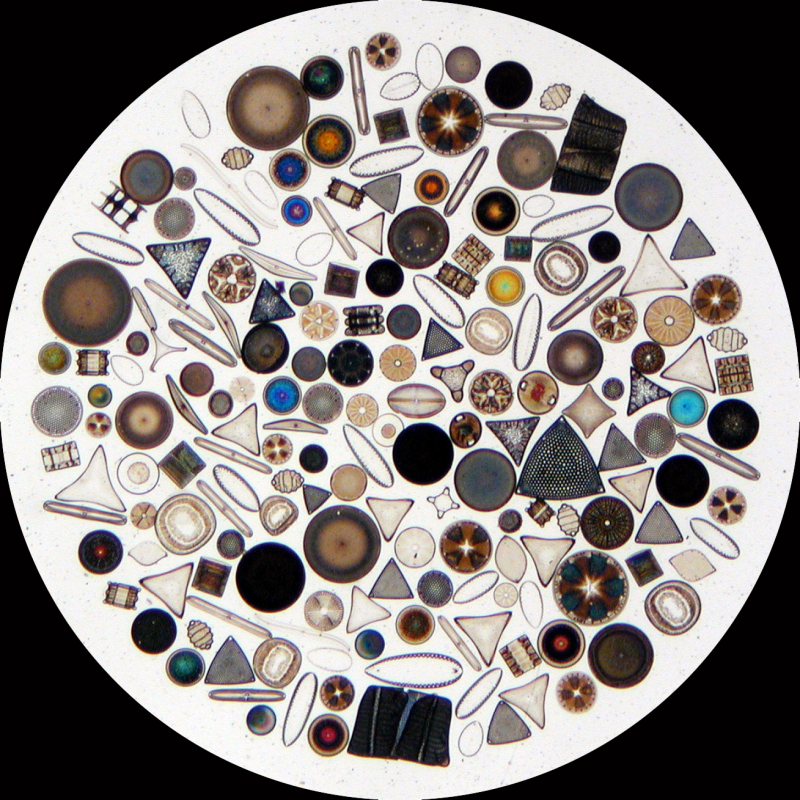 |
| Algae. It's all green and same-y. |
Some exist as single cells. Others form bizarrely-shaped colonies. Some are
bioluminescent, and light up the sea during large nocturnal gatherings. While
most drift benignly in the water column, other groups use flagellae (tails) to
propel themselves through the water, and may even supplement their
photosynthesising by hunting smaller microorganisms. This is no homogeneous
field of daisies.
 |
| Yep, allllll green and same-y. |
But algae aren’t the only tiny sun-worshippers in the sea.
Some forms of bacteria- called cyanobacteria- can also photosynthesise. In fact,
they pretty much invented photosynthesis, and they changed the world forever by
doing so. About 3 billion years ago, oxygen was almost non-existent in Earth’s
atmosphere, and any that appeared was quickly taken up by the vast amounts of
iron in the crust, creating iron oxide, or rust. As cyanobacteria evolved and
became more and more successful, their photosynthesis produced vast amounts of
oxygen. This caused mass rusting of the planet’s iron reserves, creating huge depositions
of iron oxide that appear as striking bands of bright orange in the Earth’s
crust. Once the iron sinks were exhausted, oxygen began to accumulate in the atmosphere-- great news for our
very distant, microscopic ancestors, as it led to the evolution of mitochondria
(our cells’ powerhouses) and bigger, more complex bodies. However, a vast
number of oxygen-intolerant species were lost forever in one of Earth’s largest
mass extinction events, and the planet underwent a reverse greenhouse effect, becoming
swamped in snow and ice for the next 300 million years. Not bad for an organism
that looks like a Smurf’s nose hairs.
.JPG/800px-Tolypothrix_(Cyanobacteria).JPG "Cyanobacteria by Wikimedia user Matthewjparker. CC-BY-3.0.")
Feeding on this garden of freaks is a whole host of animals
and single-celled organisms, collectively called zooplankton. Some are instantly familiar to
us: many kinds of tiny crustaceans live as plankton, including krill, the
staple food of the blue whale. Others, however, are downright weird. Amongst many examples are
tiny flying slugs known as sea angels…
 |
…amoebae with shells…

…the adorably-named tintinnids…

… and gigantic strings of clear jelly called salps.
 |
| Fun fact: the two creatures in this picture are more related than you'd think |
But whilst all of these creatures typically spend their whole
lifecycles as planktonic nomads, many others come along for the ride
exclusively during their youth. You see, childhood works a little differently
in the oceans. Land animals have had to invent all sorts of ingenious ways to
stop their developing young from drying out, mostly by confining their most
vulnerable growth phases to a nice damp waterproof capsule, such as an egg or uterus,
until they can survive in the outside world. However, to marine creatures, the
seas are just one big bath of amniotic fluid into which they can cast their
offspring without a care. Many therefore undergo bizarre planktonic larval
phases that just aren’t visible in their land-dwelling relatives, simply
because they would usually be confined to eggs or their pregnant mothers.
Take snails, for example. Land snails hatch as miniature
shelled versions of the adults, but their marine cousins go through multiple
larval stages that look nothing like the creatures they will eventually become.
The second of these incarnations is called the veliger.
 |
| Um...what? |
It flies through the water on hairy
wings, and undergoes a painful-sounding developmental process in which all of
its organs twist 180 degrees relative to the rest of its body, so that it can
fit into its developing shell. As a result, its anus ends up in a fairly inconvenient place...
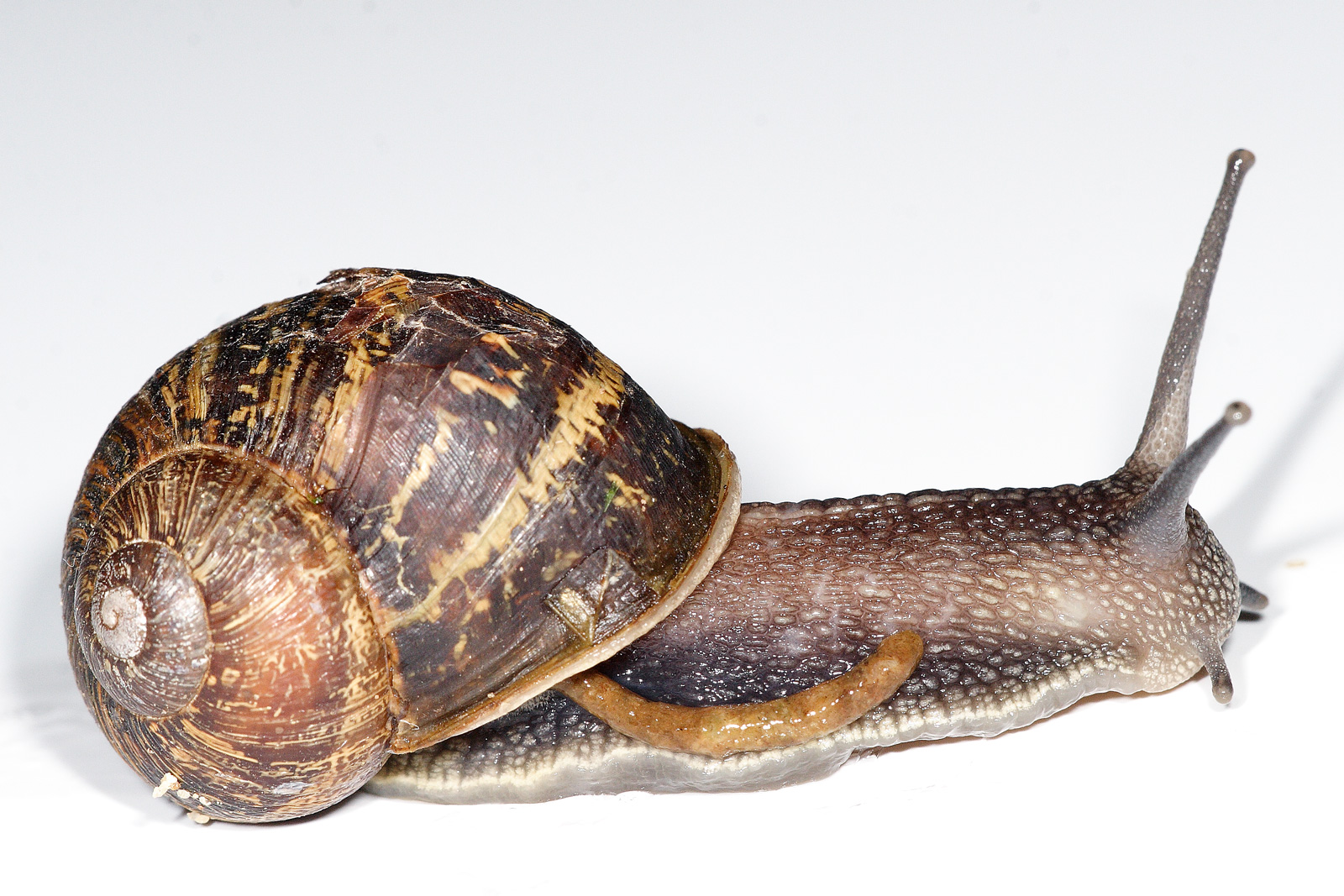 |
| All right when you're stretched out, not so great when you're napping inside... |
The larvae don’t join the plankton crowd as a kind of self-discovery
gap-year experience before they settle down. Having a tiny, mobile larval stage
is a great way for creatures that are slow or fixed to the sea floor to exploit
new parts of the ocean. This specialised dispersal phase means that some
species apparently regress to a simpler form upon reaching adulthood. For
example, larval sea squirts bear a striking resemblance to tadpoles, with eyes,
rudimentary “brains” that control their movement, complete but non-functioning
digestive tracts, and a spine-like structure called a notochord that marks them
as close relatives of the vertebrates. But when they find a suitable place to
live, they plant themselves headfirst into the ground, and absorb all of these
complex features to begin life as simple, filter-feeding adults, leaving no
trace of their relatively advanced place on the tree of life.
.jpg/538px-Sea_Squirt_Rhopalea_sp._(7945120802).jpg "Wikimedia user Bernard DUPONT, CC-BY-2.0") |
| Pretty, but brainless |
Meanwhile, some
larvae show a remarkable amount of ingenuity when searching for a new home.
Rather than drifting aimlessly and risking settlement in an unsuitable spot,
coral larvae listen for the sounds of distant reefs with the fringe of fine
hairs (cilia) on their bodies. They can distinguish the typical sounds of a
busy reef from other ocean noise with astonishing precision, allowing them to
swim towards their nearest friendly neighbourhood.
 |
| Who knew mouldy gherkins were so smart? |
For many larvae, navigating
towards a suitable permanent home is a race against time: while some are
equipped to feed, many carry a limited supply of yolk for energy, and will
eventually die if they stay adrift for too long. Fish, for example, undergo a larval
stage in which they lack fins, scales or swim bladders, and rely on a
distended belly full of yolk for sustenance.
 |
| At least you can sort of TELL that they're fish. |
As with other plankton, they must
navigate a whole suite of dangers during this time, including adult fish,
jellyfish and indiscriminate filter feeders like basking sharks.
Unsurprisingly, creatures with planktonic offspring must produce a vast number of
eggs if any are to survive their dangerous childhood in the ocean’s great
microscopic buffet.
Plankton might not have the dangerous sex-appeal of a great
white shark. Tourists seldom spend hundreds of pounds to go on boat trips to
see them. Doctors’ waiting rooms don’t contain tanks of exotic and colourful plankton
to calm the nerves of their patients. Although in our heart of hearts we know that they’re by far the most important
inhabitants of the ocean, sometimes it’s hard to appreciate plankton beyond
their supporting roles as snack bar and crèche to our favourite ocean creatures
when they’re so incredibly tiny. Even
so, their unfathomable yet practically invisible diversity is surely worth
celebration of its own. Each teaspoon of seawater is home to an otherworldly soup
of nomadic baby animals, alien algae and single-celled oddities, as different
from each other as you are from the banana in your lunchbox or the bacteria on your skin. If you find yourself struggling for inspiration, just remember: if you don’t have a microscope handy to picture them, your wildest
imagination might be just as accurate.
